At BlueCotton, one of the most common questions we hear is: What’s the difference between screen printing and direct-to-garment printing? Both methods have their place in custom apparel, but they work in fundamentally different ways and serve different purposes.
Let’s walk through the key differences between these two printing techniques, including costs, quality, durability, and when you’d want to use each one.
At a Glance
| Screen Printing | Direct-to-Garment | |
| Setup time | Cumbersome | Virtually zero |
| Time per unit | Seconds | Minutes |
| Durability | 50+ washes | ~20 washes |
| Photorealistic images | Inferior | Superior |
| Fabric compatibility | Unlimited | Very limited |
| Garment colors | Unlimited | White and some light colors |
| Quantity | Unlimited | 24 pieces or fewer |
| Ink costs | Lower | Higher |
Fundamental Differences
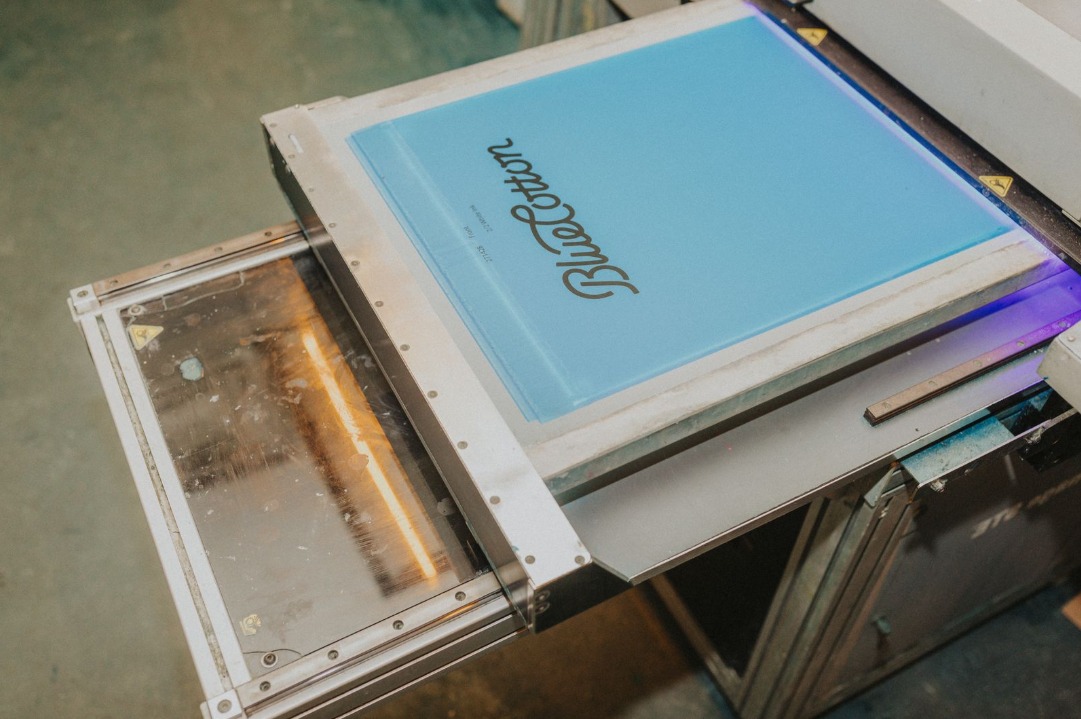
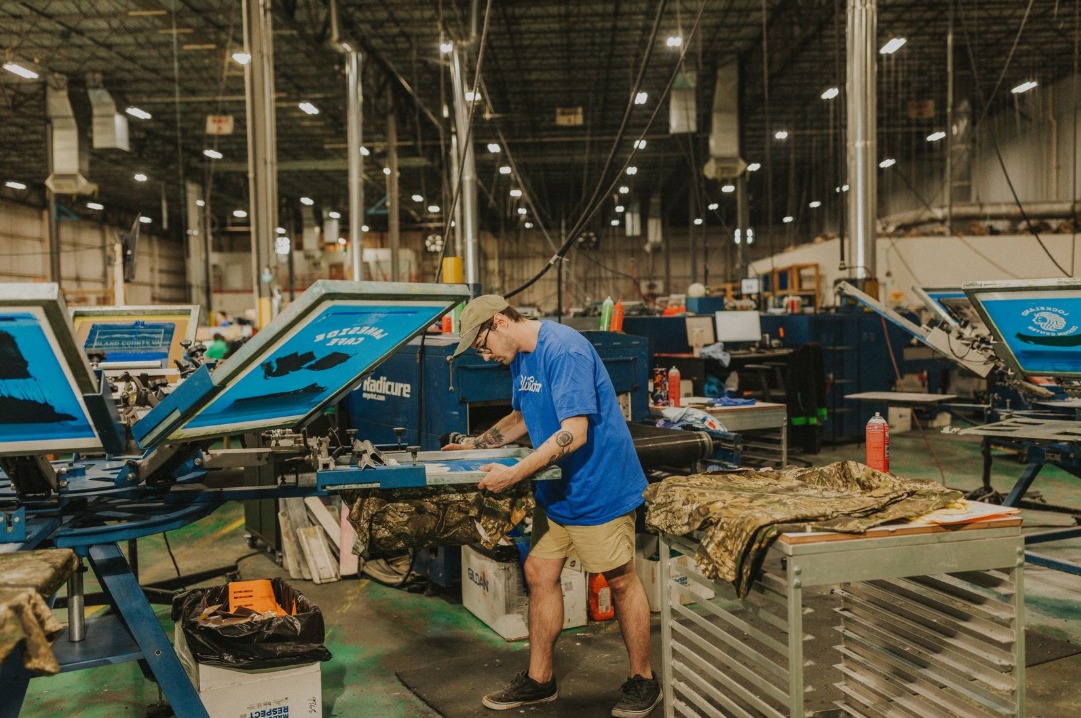
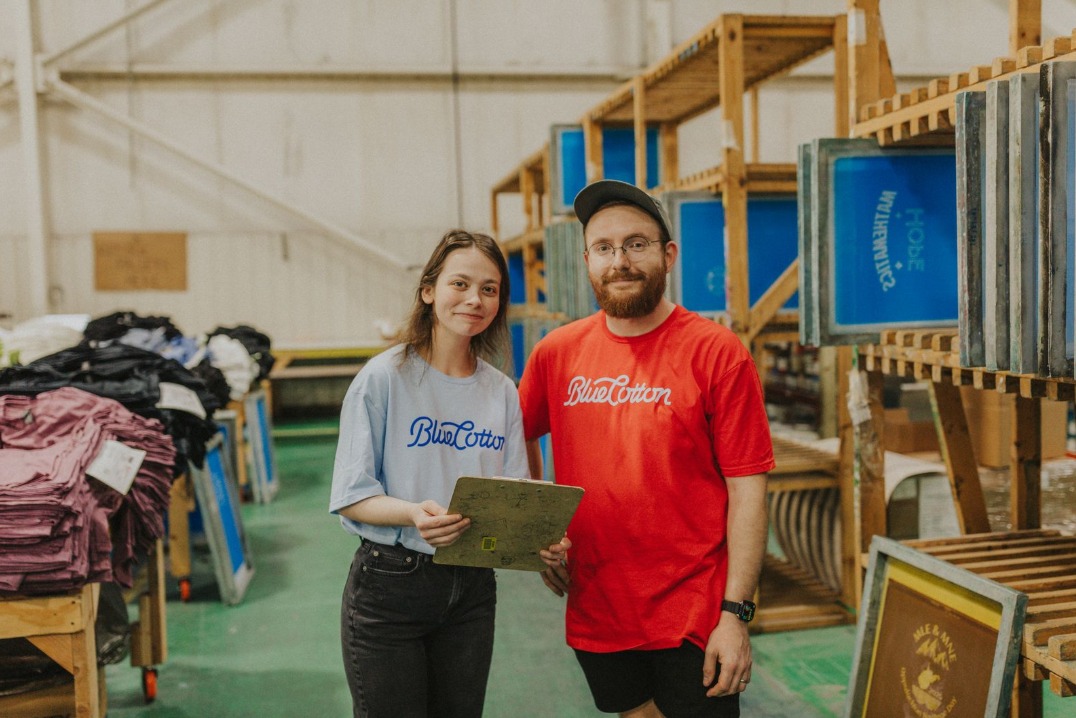
Screen printing is accomplished using aluminum frames that have a polyester or nylon mesh material stretched over them. Plastisol ink is pushed through this mesh and onto the garment, with each ink color requiring a separate screen that’s loaded onto a press (picture a big, circular machine) and registered to each other for alignment. When finished, the screen-printed ink sits neatly on top of the fabric. Then, the garment is heated at 300° to cure the plastisol ink.
It’s a fairly cumbersome process in terms of setup, but it’s extremely efficient for producing dozens to hundreds to thousands of garments.
Direct-to-garment (DTG) printing, on the other hand, uses an inkjet-style printer to apply water-based ink directly onto a garment. Think of a desktop printer that applies black ink directly onto a sheet of paper — except using a much larger printer. The garment is then loaded onto a platen (a flat surface that allows for printing), and then the printheads move back and forth across it in a way very similar to how a desktop printer works.
While screen printing can only print as many colors as the press has screens, there’s essentially no limit to the number of colors that can be printed using DTG printheads. And with a short setup time, this process is great for very small orders but not practical for hundreds of garments.
Quality
Direct-to-garment printing excels at photorealistic images, gradients, and unlimited colors. You simply can’t achieve its quality with a method like screen printing, although direct-to-film (DTF) comes close.
In terms of durability, however, screen printing is far superior to direct-to-garment printing. DTG is usually rated for 20 washes before you start to see degradation of the print. Meanwhile, screen-printed garments can easily be washed 50 times before the same degradation would appear.
Fabric Compatibility
Another extremely important factor to consider is fabric compatibility — a category that screen printing wins hands-down.
Screen printing can be applied to virtually any material: cotton, cotton/poly blend, polyester, nylon, fleece, tees, etc. It can also be applied to any color garment. This might seem obvious, but methods like direct-to-garment do not have this luxury.
It’s much harder to print DTG on anything other than white material. It’s possible, but you must first lay down a pretreatment. Unfortunately, this pretreatment often stains the garments — you can sometimes see this yourself if you look for a faint rectangle around the image on a DTG print. Also, direct-to-garment is best used on 100% cotton, since it’s very difficult to apply DTG to polyester or cotton/poly blends.
Efficiency, Speed, and Maintenance
There are also certain factors that make screen printing or DTG printing better choices for custom branding companies. While they may seem unimportant, they can affect the final price and timeline for customers.
Efficiency
After the art team prepares the image, the setup for direct-to-garment printing is minimal. Think about how much time it takes to send a file to your desktop printer… seconds at most. For screen printing, however, it can take an hour or two to manually set up a complicated image that has 6–8 colors.
For example, consider two orders of 10 shirts. A DTG order will be much more cost-effective for the provider, whereas a screen printer could take an hour to set up for just a handful of shirts. On your end, unfortunately, that means you’ll need to pay extra just to cover the labor cost of setup. So, for small orders of just a dozen shirts, DTG might make sense.
But setup costs aren’t the only costs.
There’s also the cost of printing each garment and the cost of the ink itself. Here’s where screen printing pays off — it can take several minutes to print just one garment using DTG, but that same image can be printed in a matter of seconds using screen printing. Additionally, direct-to-garment ink is much more expensive than plastisol screen print ink.
So choosing between screen printing and DTG will come down to a couple of specific factors: How many pieces of clothing are in the order, and how many colors are required? If you want lots of ink colors and very few units, direct-to-garment is the better choice. If you only need a few ink colors but lots of garments, screen printing is the clear winner.
Speed
Direct-to-garment printing can take a few minutes for each unit, and then each one has to be heat-pressed to cure the ink permanently onto the garment. This really adds up, and in a 300-piece order, a single operator might be spending their entire shift to fulfill it — perhaps even two. This amount of time can really clog up the print shop and make it difficult to produce any other orders.
Screen printing can fulfill this same order in maybe three hours, including the hour of setup time. And when these fulfillment costs are passed on to the customer in some form or fashion, it’s wise to consider whether you really want to pay for a full day’s work of DTG printing.
Equipment Maintenance
One final area to consider is the upkeep required to maintain the equipment used in DTG and screen printing. Direct-to-garment printers involve a lot of maintenance and downtime — their printheads get clogged if they’re not capped properly, and they’re quite easily damaged. To make matters worse, printheads cost thousands of dollars.
Screen printing equipment is more expensive on the front end, but a screen print press can last 20 years with relatively minor maintenance costs along the way.
These maintenance costs make very little difference when spread out over thousands of orders, but it’s still something to consider.
Making the Best Choice Between Screen Printing & DTG Printing
Direct-to-garment is a great option for certain use cases: small quantities, lots of colors, and photorealistic images (on white or light-colored fabric) make for great DTG prints.
But for the overwhelming majority of cases, screen printing is the way to go. If you want more than a handful of shirts and don’t need high-fidelity art, it’ll be more efficient, faster, and cheaper.